
Can a wallet make a DeFi transaction safer and cheaper at the same time? Sometimes—but not because a browser extension has discovered a magic gas discount. The harder truth is that security and gas optimization often depend on the same first step: understanding exactly what a transaction will do before it is signed. A swap, liquidity deposit, or token approval is not merely a button click. It is a request to change blockchain state, pay network fees, and potentially grant another contract future access to assets. A wallet can improve the decision-making layer around that request, but it cannot remove protocol risk, network congestion, or human error.
That distinction matters for US-based DeFi users, where a familiar browser workflow can make on-chain finance feel almost like ordinary online banking. The interface may be convenient; the settlement is not. Transactions are generally irreversible, gas prices change with demand, and a malicious website can present a perfectly polished signing prompt. Rabby’s role is most useful when treated as a transaction-awareness tool: a way to inspect chain, contract, assets, and expected effects before committing funds.
Myth One: A wallet can make every transaction cheap
Gas is the fee paid for computation and storage on a blockchain. On Ethereum and other EVM-compatible networks, a transaction’s cost is broadly related to the amount of computational work it requests and the fee market at that moment. A simple transfer usually requires less work than a multi-step interaction with a decentralized exchange, lending market, or liquidity pool. A wallet can help a user select an appropriate fee and sometimes identify a less expensive route, but it cannot make a complex contract call consume the same resources as a simple transfer.
The first non-obvious point is that “gas optimization” has two meanings. One is technical optimization: reducing the computation or number of on-chain actions required. The other is execution optimization: choosing a suitable network, timing, fee setting, or transaction path. Most retail users cannot rewrite a protocol’s smart contract to reduce its gas usage. They can, however, avoid unnecessary approvals, batch actions when the application supports it, and compare whether a transaction is taking place on the intended EVM chain.
Network choice creates a genuine trade-off. A lower-fee chain may reduce the dollar cost of a transaction, but it can also have different liquidity, bridge risks, contract deployments, validator assumptions, or user experience. “Cheaper” is not synonymous with “better.” A swap on a thin market may have worse price impact than a more expensive transaction on a deeper market. A bridge may advertise low fees while adding a separate layer of smart-contract and operational risk. The correct comparison is total execution cost: network fee, slippage, liquidity, approval overhead, bridge exposure, and the value of the assets at risk.
Fee settings also deserve a more careful mental model. A user who sets an extremely low fee may wait longer or see a transaction fail to be included promptly, while an unnecessarily high setting can waste money. On networks using dynamic fee markets, the wallet is estimating what may be sufficient under current conditions; it is not guaranteeing a final cost in every circumstance. The transaction’s gas limit and the fee paid for used gas are related but not identical. A higher gas limit does not automatically mean the full amount will be spent, while a limit that is too low can cause failure and still consume some fee.
Myth Two: A transaction preview is the same as a security guarantee
Transaction simulation and human-readable previews are valuable because raw calldata is difficult for most people to interpret. A preview can help reveal that a supposedly simple interaction will transfer a token, set an approval, or call a contract on a different chain than expected. This is a major improvement over signing blindly. Yet a preview remains an interpretation of the requested call, not an insurance policy.
Smart contracts can contain complex logic, depend on external data, or behave differently according to market conditions and block state. A simulation may not perfectly predict what happens when the transaction is mined. A contract can also be legitimate but economically dangerous: a leveraged position may liquidate, a liquidity pool may suffer impermanent loss, or a token may have transfer restrictions that are not obvious from the wallet screen. Wallet-level warnings cannot determine whether an investment strategy is sound.
This is where security and gas intersect. If a user approves an unlimited token allowance, the immediate transaction may be only one approval fee. The larger risk is future: if the approved contract is compromised or malicious, it may be able to move tokens later without another approval prompt. A smaller, purpose-specific allowance can limit potential damage, although it may require additional transactions and therefore more gas. Revoking an allowance later also costs gas. The decision is not simply “maximum security versus minimum cost”; it is a risk budget shaped by asset value, contract trust, transaction frequency, and network fees.
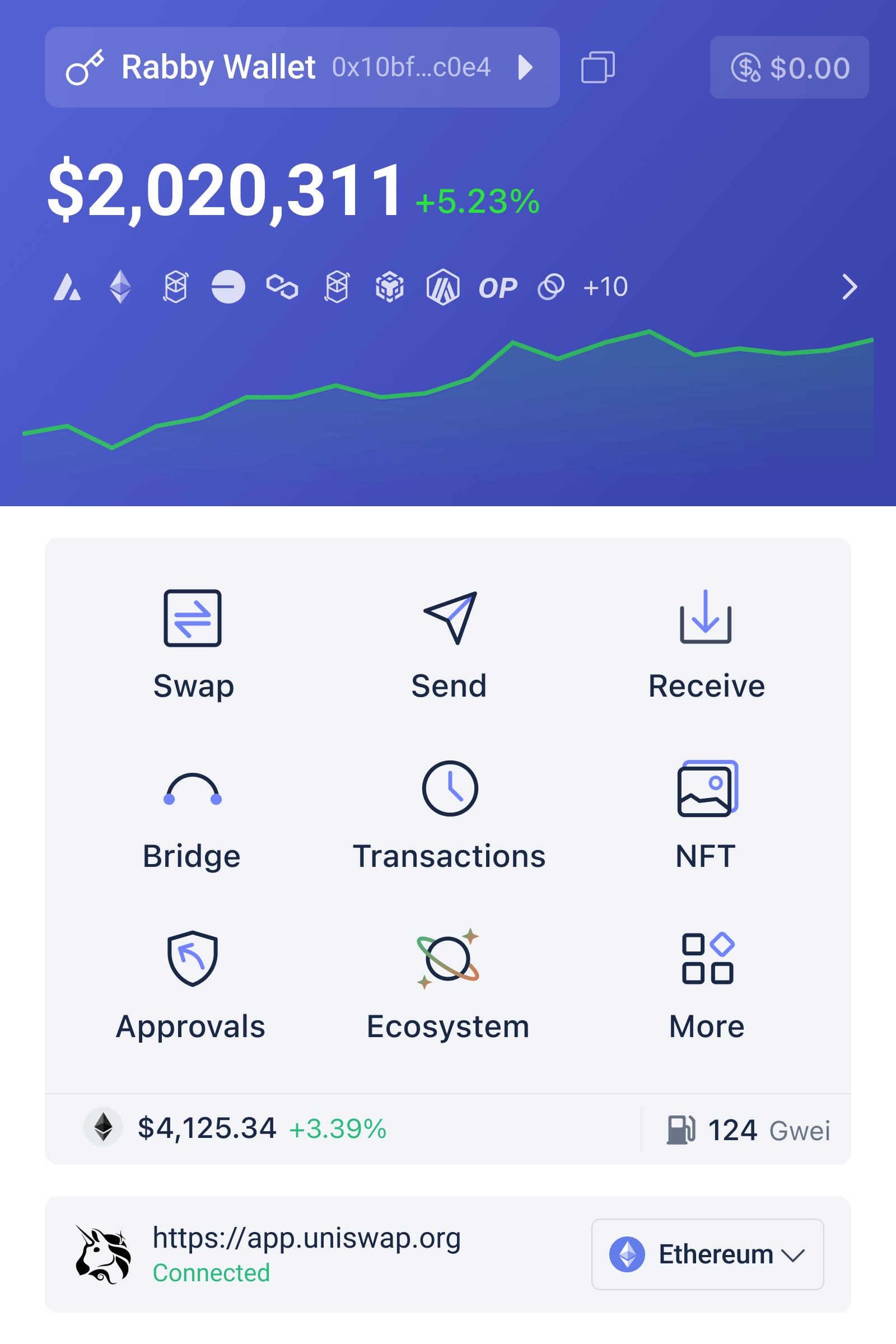
Rabby can be useful in this review process because it is designed for Ethereum and EVM environments and can present transaction information in a way intended to be more intelligible than raw contract data. The supplied project update describes the extension as available for Chrome and Brave and positions it as a wallet for EVM chains. That broad compatibility is practical for users who move among EVM-based applications, but it also creates a boundary: supporting many networks does not mean every application, bridge, token, or contract on those networks is safe.
If you are installing the browser extension, use the project’s official distribution path and verify the publisher, domain, and browser permissions before entering any seed phrase. A legitimate wallet will not need a secret recovery phrase pasted into a website to “activate” an extension. For readers checking the installation route, the rabby extension download should still be evaluated with the same discipline: confirm the source independently, avoid sponsored search results that imitate wallet pages, and never treat a familiar logo as proof of authenticity.
Three wallet approaches, three different compromises
A browser extension is often the most convenient option for active DeFi users. It can connect directly to decentralized applications, display signing prompts in the same desktop workflow, and make it easier to inspect a transaction before approval. The compromise is exposure: browser security, phishing, malicious extensions, clipboard attacks, and a user’s tendency to approve quickly all become part of the threat model. A browser wallet should be treated as a signing instrument, not as a vault that makes every connected website trustworthy.
A hardware wallet changes the compromise rather than eliminating it. The private key is designed to remain isolated from the connected computer, which can reduce the impact of some malware scenarios. But the user can still sign a malicious transaction if the request is misunderstood, and hardware screens may not explain complex DeFi calls clearly. Hardware security is strongest when paired with careful address verification, sensible account separation, and a habit of reading the transaction rather than approving by reflex.
A mobile wallet can be convenient for monitoring positions and handling smaller transactions, particularly when a user values portability. Its risks shift toward phone compromise, backup exposure, social engineering, and rushed approvals on a smaller screen. A smart account or account-abstraction wallet may add features such as spending policies, sponsored fees, or batched actions where supported. Those features can improve usability and sometimes reduce operational friction, but they introduce additional components and assumptions. More automation can mean more complexity to understand.
For many users, the strongest arrangement is not choosing one wallet for everything. A browser wallet may handle routine DeFi activity with limited funds, while a hardware-backed account stores long-term holdings. Separate accounts can also isolate experimental applications from savings. This does not guarantee safety, but it limits the blast radius when a website, approval, or contract interaction turns out to be harmful.
A practical framework for safer, cheaper execution
Before connecting, ask whether the website itself is authentic. Check the domain character by character, avoid links delivered through unsolicited messages, and be cautious when a site pressures you with urgency. A fraudulent page can connect to a real wallet and request a real transaction. Wallet software can flag suspicious behavior, but it cannot repair a compromised browsing habit.
Before signing, identify five things: the network, the destination contract, the asset leaving your account, the asset expected in return, and any approval being granted. If one of these is unclear, stop. A token symbol alone is not enough because unrelated contracts can use similar names and tickers. The wallet address and contract context matter more than the branding displayed by the application.
Then examine the economic result, not only the gas estimate. A swap with low gas can still be expensive if slippage is high. Slippage is the difference between the expected execution price and the actual price the market permits. In a thin pool, saving a small network fee may be irrelevant if the trade moves the market against you. Likewise, a failed transaction can consume gas without producing the intended result, so repeated retries are not a reliable optimization strategy.
For approvals, consider the value and frequency of use. A limited allowance may be appropriate for a new or infrequently used application. A larger allowance may reduce repeated approval transactions for a well-understood contract, but it increases the amount potentially exposed if that contract or account becomes compromised. Periodically reviewing and revoking unused approvals can improve hygiene, although each revocation is itself an on-chain transaction with a fee.
Finally, keep a small test transaction in the workflow when the stakes are high or the application is unfamiliar. A test does not prove that a protocol is safe, but it can reveal a wrong network, incorrect recipient, unexpected token behavior, or an interface problem before the full amount is committed. The cost of that test should be weighed against the potential loss, not against the desire to minimize every last cent of gas.
What to watch as wallet security evolves
The next useful improvements are likely to come from better interpretation rather than simply lower fees. If wallets can explain contract effects more accurately, distinguish routine calls from unusual approvals, and present chain-specific warnings without overwhelming users, they may reduce the most common source of loss: signing something the user did not understand. This is a conditional scenario, not a guarantee. Better warnings can also create alert fatigue if every interaction appears equally alarming.
Broader EVM support may make it easier for users to move between applications and networks, especially as the supplied weekly project news emphasizes Chrome, Brave, and an on-chain wallet experience across EVM chains. The corresponding risk is operational complexity. More chains mean more opportunities to select the wrong network, use a counterfeit token, or assume that a familiar contract behaves identically elsewhere. Users should watch whether wallet interfaces make those differences clearer, not merely whether they add more supported networks.
The durable lesson is simple but easy to ignore: gas optimization is not the same as paying the smallest visible fee, and security is not the same as seeing a warning-free screen. The better objective is efficient, bounded-risk execution. Use the wallet to inspect what is being requested, compare the full economic cost, separate high-value holdings from experimental activity, and treat every signature as a permission with consequences.
Frequently asked questions
Does Rabby eliminate the need to verify a DeFi transaction?
No. A transaction preview can make contract calls easier to understand and may highlight unusual behavior, but it cannot guarantee that a protocol is solvent, that a token will retain value, or that a sophisticated contract has no exploitable flaw. Users still need to verify the website, network, recipient, approvals, and economic terms.
What is the safest way to reduce gas costs?
Start by avoiding unnecessary transactions: check whether an approval is already active, use the intended network, avoid repeated failed submissions, and compare total trade cost rather than gas alone. Batch operations or lower-fee EVM networks may help when supported, but they can introduce different liquidity, bridge, or protocol risks. The cheapest transaction is not automatically the safest or best-value transaction.
Should a browser extension hold all of my crypto?
For many DeFi users, separating funds by purpose is more prudent than concentrating everything in one hot wallet. Keep only the amount needed for active applications in a browser-connected account, and consider stronger isolation for long-term holdings. No setup removes all risk, but account separation can reduce the consequences of one mistaken signature.
No comments yet.